 Metrics for project management performance can be summed up in the following categories: the effectiveness of the project, the effectiveness of the processes, and the maturity of the processes. Project effectiveness category includes measurements of the project development in terms of cost, time and quality. Process effectiveness metrics help analyze the efficiency and relevance of the processes against the type and scale of the project. Process maturity metrics indicate the level of consistency and control of the process. The key indicator of project process maturity is risk management.



Read Why do business professionals choose ready-to-use KPIs? to find out the answers to these questions:

Ideally, you need to have a strategy (in a form of a strategy map) before you start thinking about the ways to measure its execution (KPIs). Don't have a strategy map yet? Use free Strategy Map Wizard to create a strategy map for your current business challenges. The wizard will:
The whole process takes on average 6 minutes. Give it a try right now - it's free.
 bonus.
Comparing own performance with one who does better than you can have two results- 'turning green with jealousy' or 'using it for self-improvement'. The latter concept when followed by companies gives rise to what is termed 'benchmarking'.
This procedure of structuring benchmarks however, demands adopting a highly detailed structure in which the practices being followed in the concerned organization are seen in the light of the ones being followed in industry leaders. Further, improvements are carried out to match those practices as closely as possible are conducted.
At times, cross-industry comparisons are also done as similar steps can be followed at other places. Due to the very wide spread of this thought, it often turns out to be a really lengthy process. However, one cannot compromise on the steps of the process. So, the analysis has to be carried out giving it the due importance and time for reaping the desired benefits.
This act of 'performance comparison' makes it possible for organizations to have 'best of all the worlds' thereby moving ahead of the oft followed 'best of both the worlds' idea. On an ending note, the job of 'performance benchmarking' does not end at the introduction of this strategy in the organization but has to be continued for which a benchmarking scorecard comes to help. By using this strategy, one can smoothly go for improvement benchmarking in the organization.
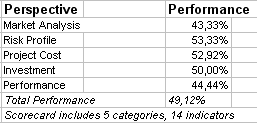
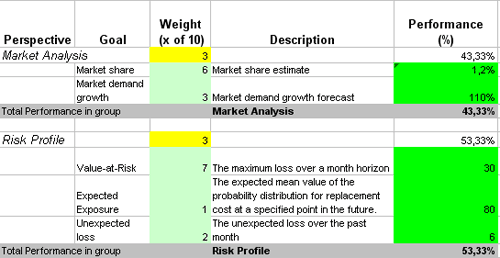
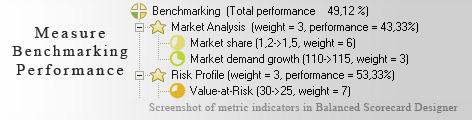
This is the actual scorecard with Benchmarking Performance Indicators and performance indicators. The performance indicators include: benchmarking, market analysis, market share, market demand growth, risk profile, value-at-risk, expected exposure, unexpected loss, project cost, avg. monthly labor cost, downtime cost, cost of defect, investment, return on investment, investment efficiency, investment growth, performance, productivity, time to market, defect detection.
Download a trial version of Benchmarking Evaluation Balanced Scorecard or purchase a full version online.
How is this book different from 796 other book titles about KPIs on Amazon?
"Before writing a single line, I formulated some guiding principles, one of them was: "If our clients ask, "How can I find a good KPI for..." - I want this book to provide a perfect answer."