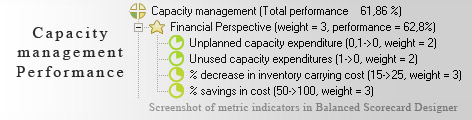
 Capacity is defined as the ability of a firm to manufacture products in a given period of time. Capacity management is essential for all manufacturing firms as it helps in directing their operations towards advanced productivity. It includes capacity planning, controlling, scheduling and measurement of available capacity. The KPIs help in deciding which techniques are effective in managing capacity in an appropriate way.The KPIs are classified into four perspectives: Financial, Operational, Internal process and Capacity planning perspective.Financial perspective consists of KPIs as unplanned capacity expenditure, unused capacity expenditure, % decrease in inventory carrying cost and % savings in costs. It refers to the costs and savings involved in acquiring, maintaining and controlling production capacity.Operational perspective has KPIs such as order fulfillment cycle time, number of complaints due to non-delivery, % productivity improvement and % reduction in man-hour wastage. This perspective helps in judging the operations of the company.Internal process perspective involves KPIs that help in gaining an insight of the internal processes. The KPIs for this perspective can be resolution time, % reduction in manufacturing cycle time, accuracy of capacity forecasts and % reduction in re-work and scraps.Capacity planning perspective includes KPIs like % process monitored for capacity planning, capacity adjustments incidents, % reduction in delivery failures and % reduction in inventory levels. It refers to the measures that help in proper planning of capacity that ultimately leads to better quality and services.



Read Why do business professionals choose ready-to-use KPIs? to find out the answers to these questions:

Ideally, you need to have a strategy (in a form of a strategy map) before you start thinking about the ways to measure its execution (KPIs). Don't have a strategy map yet? Use free Strategy Map Wizard to create a strategy map for your current business challenges. The wizard will:
The whole process takes on average 6 minutes. Give it a try right now - it's free.
 bonus.
Essentially capacity management is aimed at optimizing the capacity of the organization to meet the future demands, that too in a cost-effective way. To achieve this, prudent and well-planned decisions are implemented so that investment is done only in those equipments and resources that will actually pay in future.
The solutions covered under this umbrella of capacity optimization are concerned with application of statistical measures to identify the bottlenecks in processes, obtain estimates for capacity requirements and come up with generation of reports and alerts in an automated fashion.
There are three sub-processes comprised in this domain of managing capacity- Business Capacity Management, Service Capacity management and component Capacity management.
The key is to be pro-active in approach and bring effectiveness along with efficiency in the organizational operations.
However, there are certain hurdles one needs to overcome during the administration of this concept; these being 'difficulty in stability and efficiency due to involvement of agents which make the process lengthy' and 'limitations in modeling and monitoring ask for lot of manual analysis'.
These issues can be taken care of by going with a capacity management scorecard that has the important metrics on it and is therefore capable of reflecting the progress in timely manner.
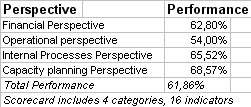
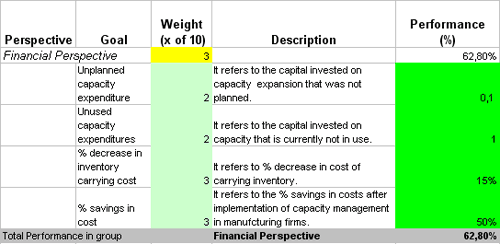
This is the actual scorecard with Capacity management Performance Indicators and performance indicators. The performance indicators include: capacity management, financial perspective, unplanned capacity expenditure, unused capacity expenditures, % decrease in inventory carrying cost, % savings in cost, operational perspective, % reduction in order fulfillment time, number of complaints due to non-delivery, % productivity improvement, % reduction in man-hour wastage, internal processes perspective, resolution time, % reduction in manufacturing cycle time, accuracy of capacity forecasts, % reduction in reworks and scraps, capacity planning perspective, % process monitored for capacity planning, capacity adjustments incidents, % reduction in delivery failures, % reduction in inventory levels .
Download a trial version of Capacity management Evaluation Balanced Scorecard or purchase a full version online.
How is this book different from 796 other book titles about KPIs on Amazon?
"Before writing a single line, I formulated some guiding principles, one of them was: "If our clients ask, "How can I find a good KPI for..." - I want this book to provide a perfect answer."