 Obviously measuring personal productivity is important, and the reasons why are obvious. If you do not know how your staff is doing, then how can you truly know the inner workings of your own company? Staff discontent can put your company in serious jeopardy, while on the other hand, high staff productivity can be your best company asset. But without measuring these two extremes, and which way your staff might be moving towards them, how will you ever know? Not knowing your company's inner workings should never be a part of the way you do business. Decisions that are made towards sales, whether buying or selling, are also impacted by your company's staff. If your finances are declining because high labor costs are causing a drain on savings that could be used for making important company purchases, you would be unaware, without actually measuring, which areas need the improvement. On the other hand, if you do measure your staff's productivity, then you will know, for example, which employees should be rewarded, for high performance levels, that are saving your company money.



Read Why do business professionals choose ready-to-use KPIs? to find out the answers to these questions:

Ideally, you need to have a strategy (in a form of a strategy map) before you start thinking about the ways to measure its execution (KPIs). Don't have a strategy map yet? Use free Strategy Map Wizard to create a strategy map for your current business challenges. The wizard will:
The whole process takes on average 6 minutes. Give it a try right now - it's free.
 bonus.
'Productivity' constitutes the central issue around which revolves every step and move an organization takes. All objectives and purposes aim at adding to the organizational productivity. Productivity is about utilizing whatever inputs are available 'at the fullest'.
This field asks for a significant command over statistical aspect as calculations form a major part of 'productivity judgment'.
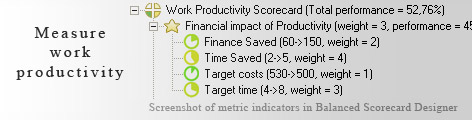
One is required to frame 'manageable' number of metrics to help the organization analyze its productivity levels from different angles. By preventing the values of these indicators from moving out of the suggested range, one can ensure that intended path is traced. Stating it in other words, optimum utilization of resources, both physical and human is possible by adopting KPIs (Key performance Indicators) to measure and track movements.
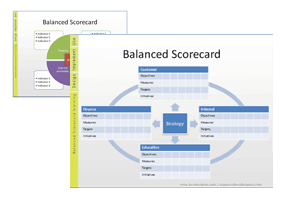
These metrics are organized on a Balanced Scorecard and kept for future references. This strategy renders the organizational processes 'much needed' transparency. Employees, in turn feel more attached and involved with the organization. Such sense of belongingness causes them to go 'out of place', if need be.
On the whole, by continuous monitoring of the degree of productivity an organization manages, one can maximize the returns.
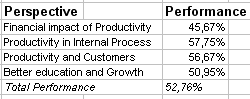
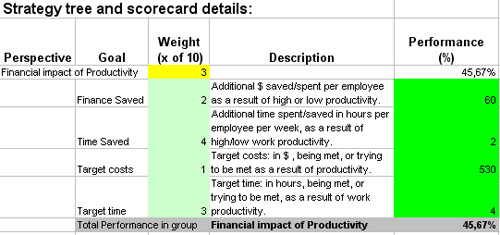
This is the actual scorecard with Productivity Measures and performance indicators. The performance indicators include: financial impact of productivity, productivity in internal process, morale improvement, goals efficiency, problems solving efficiency, projects success rate, productivity and customers, better education and growth, implementation speed, new opportunities ratio, courses efficiency.
Download a trial version of Productivity Estimation Balanced Scoreboard or purchase a full version online.
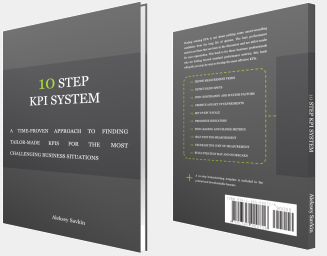
How is this book different from 796 other book titles about KPIs on Amazon?
"Before writing a single line, I formulated some guiding principles, one of them was: "If our clients ask, "How can I find a good KPI for..." - I want this book to provide a perfect answer."