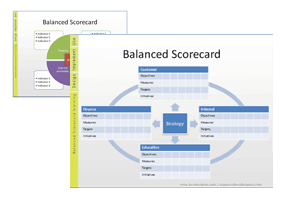
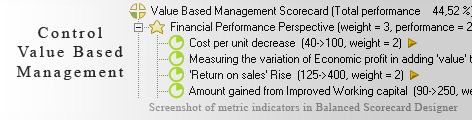
 Taking forward and keeping alive the motive of operating an organization asks for contributing to the 'value' that is provided to the stakeholders. Attaining this demands a constant check on the processes being followed in the organization in a multi-directional way. BSC can serve the purpose in this sense. The perspectives that can be of help in this subject are- Financial Performance Perspective, Customer satisfaction and Value Perspective, Innovation and Value aspects of Products and Employee Satisfaction and Learning perspective. The KPIs that can be clubbed under these headings are- 'cost per unit decrease', 'measuring the variation of Economic profit in adding value to investors' wealth', 'gain from improved working capital usage and Market share Growth. Customer satisfaction and value perspective entails metrics like 'level of customer service'; 'customer retention ratio'; 'fraction of customer base that considers the outputs beyond expectation' and 'Re-purchase possibility'. Innovation Efforts and Value contained in Products can be attained with indicators such as 'fall in product defect rate'; 'research Funds: Revenues'; 'Quality Enhancement ratio' and 'rise in number of products developed'. Lastly, the Employee satisfaction and learning can be had with parameters such as 'number of training sessions held'; 'motivation level'; 'fall in the 'accidents' ratio' and 'employee productivity ratio'.



Read Why do business professionals choose ready-to-use KPIs? to find out the answers to these questions:

Ideally, you need to have a strategy (in a form of a strategy map) before you start thinking about the ways to measure its execution (KPIs). Don't have a strategy map yet? Use free Strategy Map Wizard to create a strategy map for your current business challenges. The wizard will:
The whole process takes on average 6 minutes. Give it a try right now - it's free.
 bonus.
Among the various ways in which it is possible to put down an organization's aim, 'managing value of outputs' is one in the lot. This is to say that companies that are on a constant look-out for ways to add value to outputs stand greater chances of tasting success.
This has made 'value based management' one of the priorities recognized in firms. The subsets comprised under this bigger domain of management strategy are 'creation of value', 'managing value' and 'measuring value'.
The various objectives which VBM advocates to be achieved are 'corporate mission', 'corporate vision', 'communication', 'culture' etc.
A BSC (Balanced Scorecard) that has been specifically tailored according to the needs and requirements of the concerned organization has the potential to serve 'calculative' aims of the management. In other words, by owning a connected group of metrics, user can make sure that everything goes well and is within control.
Such a scientific way to 'enhance shareholder value' is a sure-shot means for reaching the pre-decided objectives and targets in timely manner. One can also use it to become pro-active in approach and get on to tasks.
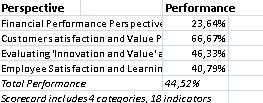
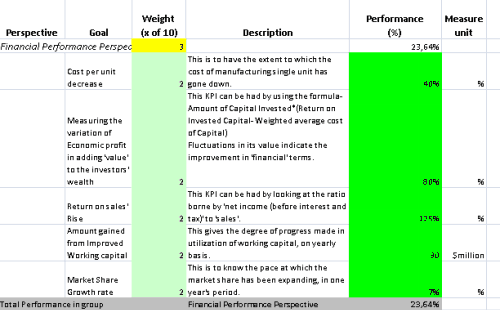
This is the actual scorecard with Value Based Management Performance Indicators and performance indicators. The performance indicators include: financial performance perspective, cost per unit decrease, measuring the variation of economic profit in adding value to the investors wealth, return on sales rise, amount gained from improved working capital, market share growth rate, customer satisfaction and value perspective, level of customer service, customer retention ratio, fraction of customer base that considers the products or services beyond expectations, re-purchase possibility, evaluating innovation and value aspects of products, research funds: revenues, % drop in new product development time, defect rate fall, quality enhancement level, rise in number of products developed, employee satisfaction and learning perspective, productivity growth ratio, drop in illness/accident ratio, motivation level, number of training sessions in one year.
Download a trial version of Value Based Management Estimation Balanced Scoreboard or purchase a full version online.
How is this book different from 796 other book titles about KPIs on Amazon?
"Before writing a single line, I formulated some guiding principles, one of them was: "If our clients ask, "How can I find a good KPI for..." - I want this book to provide a perfect answer."