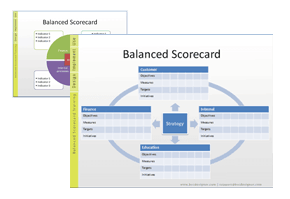
 For their proper functioning Museums/Exhibitions need to have clear and defined definition of their aims and objectives. Also, this must be communicated to the staff members in as precise manner as possible. One can attain this by putting down useful and specific indicators clubbed into four specific categories- 'Partnership and Profile Extension', 'Internal Operations', 'Quality of Experience and Community Engagement' and 'Management'.Quality of Experience and Community Engagement can be analyzed using the metrics like 'number of interactions', 'number of exhibitions held', 'visitor satisfaction level 'and'% increase in first-time visitors'.Profile and Partnership Extension is needed to ensure that enough monetary support is always available. The parameters, which can offer help in this issue, include 'positive media coverage ratio', 'amount of cash and in-kind sponsorship', 'number of collaborative projects till date', and 'rise in community involvement'.Internal Operations can be measured with indicators such as 'rise in collection state', 'number of publications/ articles', 'fraction of items on display' and 'number of educators as fraction of total staff size'.Management Perspective can be attained using KPIs like '% increase in funds on yearly basis', 'endorsed acquisition guidelines ratio', 'number of instances when damage occurred to the possessions' and 'median cost in serving a visitor'.



Read Why do business professionals choose ready-to-use KPIs? to find out the answers to these questions:

Ideally, you need to have a strategy (in a form of a strategy map) before you start thinking about the ways to measure its execution (KPIs). Don't have a strategy map yet? Use free Strategy Map Wizard to create a strategy map for your current business challenges. The wizard will:
The whole process takes on average 6 minutes. Give it a try right now - it's free.
 bonus.
Museum Management comprises the efforts taken to ensure that everything in the place goes well. The stuff kept at such places needs tremendous care to successfully manage the exhibits held at the place. This is because it is often related to the national heritage of the concerned country. One is required to make arrangements for suitable management of these 'displaying places' is needed to provide the 'desired experience' to visitors.
Often, the management of Museum requires collaborations with a number of other parties. This also calls for going with a 'tracker'.
One can attain this by structuring a balanced scorecard to measure the steps. However, this choice of metrics should be done after paying attention to all the aspects involved. Post the selection of KPIs (Key Performance Indicators), one can hand over the responsibility of measuring and managing performance at the Museum to these indicators.
By regular consultation to these metrics, one can keep a check on the movements and steps being taken by the management. It is possible to pull a number of aspects together by employing this management instrument. This forms one of the strengths of this management strategy.

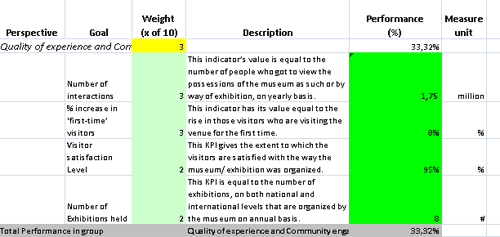
This is the actual scorecard with Museum Management Dashboard and performance indicators. The performance indicators include: quality of experience and community engaging perspective, number of interactions, % increase in ‘first-time’ visitors, visitor satisfaction level, number of exhibitions held, partnership and profile extension perspective, positive media coverage fraction, amount of cash and in-kind sponsorship, rise in community involvement, number of collaborative projects till date, internal operations perspective, rise in collection state, number of publications/articles, fraction of items on display, number of educators as fraction of total staff size, management perspective, ‘endorsed acquisition guidelines’ compliance ratio, number of instances of damage to the property, % increase in funds, on yearly basis, median cost borne in serving a visitor.
Download a trial version of Museum Management Evaluation Balanced Scoreboard or purchase a full version online.
How is this book different from 796 other book titles about KPIs on Amazon?
"Before writing a single line, I formulated some guiding principles, one of them was: "If our clients ask, "How can I find a good KPI for..." - I want this book to provide a perfect answer."