 One of the most widely used measurement framework among financial institutions and insurance companies is RAROC (risk-adjusted return on capital) based on economic profit or return-based metric system. This methodology was suggested by Tom Wilson of Mercer Oliver Wyman. RAROC is used to analyze risk-adjusted financial performance and provide a consistent view of profitability across businesses. RAROC is broadly defined as the ratio of risk adjusted return to economic capital. This use of capital based on risk improves the capital allocation across different functional areas of banks in which capital is placed at risk for an expected return above risk-free.



Read Why do business professionals choose ready-to-use KPIs? to find out the answers to these questions:

Ideally, you need to have a strategy (in a form of a strategy map) before you start thinking about the ways to measure its execution (KPIs). Don't have a strategy map yet? Use free Strategy Map Wizard to create a strategy map for your current business challenges. The wizard will:
The whole process takes on average 6 minutes. Give it a try right now - it's free.
 bonus.
Retail Banking is the one where banking institutions conduct all transactions with customers themselves and not other corporations. Some of the services provided under this umbrella are- checking accounts, savings accounts, debit cards, credit cards and mortgages.
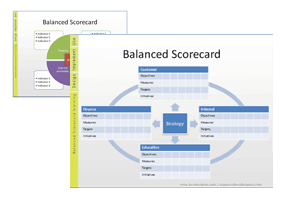
Due to the large variety of services offered by these companies, it gets compelling enough to bring in a 'performance measurement and management tool' into picture. This is often a BSC (Balanced Scorecard) that emphasizes the usage of quantitative methodology in the monitoring process. It was devised by Norton and Kaplan in 1990s.
However, spotting the right metrics can get a bit troublesome at times. In such situation, the basic definition has to be kept an account of. One should opt for only those KPIs (Key Performance Indicators) that truly and honestly can convey the progress being made in the field of Retail Banking.
Moving ahead, carrying out this task asks for a substantial grip on the subject. However, once a 'satisfactory' group of metrics has been established, tracking responsibility can be transferred to it and one can take a sigh of relief. By paying regular visits to this set of values, it is possible to keep things within control.
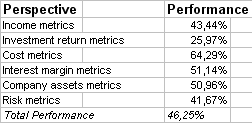
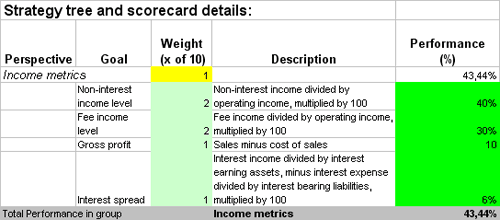
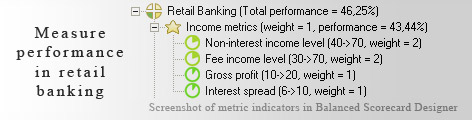
This is the actual scorecard with Retail Banking Dashboard and performance indicators. The performance indicators include: non-interest income level, fee income level, return on capital employed, return on operating capital, overhead cost ratio, interest margin metrics, operating margin, interest margin, return on average assets, capital adequacy ratio.
Download a trial version of Retail Banking Estimation Balanced Scoreboard or purchase a full version online.

How is this book different from 796 other book titles about KPIs on Amazon?
"Before writing a single line, I formulated some guiding principles, one of them was: "If our clients ask, "How can I find a good KPI for..." - I want this book to provide a perfect answer."